.png)


Most revenue dashboards lead with one number: total pipeline. It's the wrong number to lead with. A big pipeline that moves slowly generates less revenue than a smaller one that moves fast, and total pipeline hides which of those two you actually have.
Pipeline velocity fixes that. It rolls the four things that decide how much revenue you generate into a single figure: how fast money is actually moving through your pipeline. This guide covers what it is, the formula, a worked example, and where to push to move the number. If you'd rather just see your own figure, our free pipeline velocity calculator works it out in under a minute.
Pipeline velocity is the rate at which revenue moves through your sales pipeline, usually expressed as revenue generated per day. It combines four inputs (number of open opportunities, average win rate, average deal size and average sales-cycle length) into one number, so a change in any of them shows up in a single, trackable figure.
The standard formula is:
Pipeline velocity = (Opportunities x Win rate x Average deal size) / Average sales-cycle length
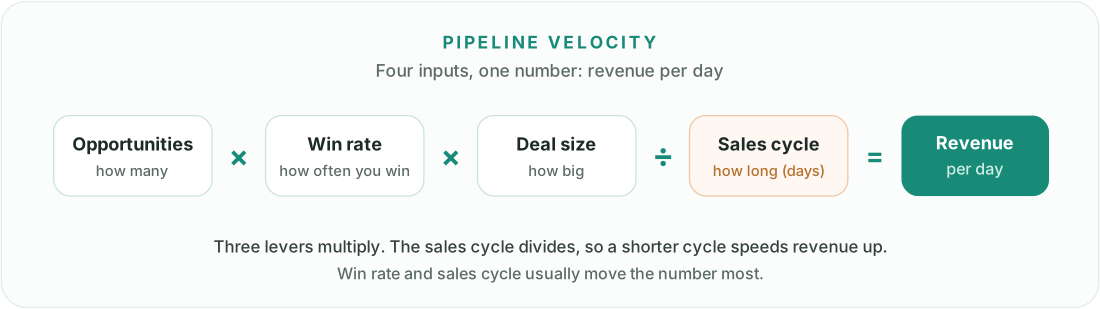
Multiply the first three, divide by the fourth, and you get revenue per day. Three of the inputs push velocity up as they grow. The fourth, sales-cycle length, sits on the bottom of the equation, so the shorter it gets, the faster revenue moves.
Take a team with 100 open opportunities, a 25% win rate, an average deal size of $15,000, and a 60-day sales cycle.
(100 x 0.25 x $15,000) / 60 = $6,250 per day.
Shorten the sales cycle from 60 days to 45 and change nothing else:
(100 x 0.25 x $15,000) / 45 = $8,333 per day. A third more revenue per day from one change, on the same pipeline and the same win rate.
Because velocity is one formula with four inputs, there are only four ways to move it, and they're not equal.
Win rate and sales-cycle length are usually the highest-leverage pair. Win rate multiplies the whole top line and sales cycle divides it, so improving qualification (fewer bad deals in, better deals closing faster) often moves velocity more than simply adding opportunities. Adding raw volume feels productive, but if those extra deals carry the same win rate and the same cycle, you're scaling the average, not improving it.
Deal size moves velocity proportionally, but it's usually the slowest lever to change deliberately. It tends to follow from better targeting and packaging rather than a switch you flip this quarter.
Opportunity volume is the lever most teams reach for first because it's the most visible. It works, but it's the easiest to break: more volume with worse qualification can lower your win rate and lengthen your cycle at the same time, and the formula quietly cancels out the gain.
The practical takeaway: before you pour more leads in, check whether tightening qualification or removing friction from the cycle would move the number more. Our calculator shows the impact of a 10% improvement to each lever side by side, so you can see which one is worth your time before you commit to it.
This is the question everyone asks, and it's the wrong one. There's no universal "good" pipeline velocity, because the number is shaped by your deal size, your motion, and your market. A team selling $200,000 enterprise deals on a nine-month cycle and a team selling $5,000 deals on a two-week cycle will have completely different velocity figures, and neither tells you anything about the other.
The benchmark that matters is your own. Measure velocity this quarter, change one thing, measure it again. A velocity number that is trending up means your system is getting healthier. A number that's flat while you add headcount means you're buying volume to paper over a qualification or cycle-time problem. Chasing someone else's benchmark just tells you how similar your business is to theirs, which is rarely the thing you need to know.
Every real improvement traces back to one of the four levers, and most of them are systems problems rather than effort problems.
Improve win rate by qualifying on intent, not activity. Most pipelines are full of deals that were never going to close, which drags the win rate down and stretches the average cycle. Scoring leads on genuine buying signals rather than form fills keeps the weak deals out in the first place. We wrote about how to do that in our guide to signal-based lead scoring.
Shorten the cycle by removing the dead time between signal and action. A lot of "long sales cycle" is really lag: a buyer shows intent and nobody acts for three days. Faster routing and better context at the point of contact compress that. This is one of the things a GTM engineering approach is built to fix.
Protect deal size and volume with the architecture underneath. Bigger deals and cleaner volume come from targeting the right accounts and engaging the full buying committee, which is a revenue architecture question more than a sales-effort one.
The pattern across all four: velocity moves when the system feeding your pipeline gets smarter, not when your team simply works harder.
If you want your own number rather than the theory, the pipeline velocity calculator takes your four inputs, returns your revenue-per-day figure, shows which lever would move it most, and lets you model a few scenarios side by side. It also scores how signal-driven your current setup is, which is usually the real constraint on the levers. Free, no sign-up.
Multiply the number of open opportunities by your win rate (as a decimal) and your average deal size, then divide by your average sales-cycle length in days. The result is the revenue your pipeline generates per day. Keep the inputs consistent each time you measure so the trend is comparable.
There is no universal benchmark. Velocity depends on your deal size, sales motion and market, so a "good" number for an enterprise team selling six-figure deals looks nothing like a good number for a high-volume, low-ticket team. The figure to watch is your own, tracked over time. Up and to the right is good; flat while you add cost is not.
Quarterly is enough for most teams, with a monthly read if your cycle is short. Measure often enough to see a trend, but not so often that normal week-to-week noise looks like a real change. The point is the direction of travel, not the decimal.
Usually win rate or sales-cycle length rather than raw volume, because better qualification both lifts the top of the formula and shortens the cycle at the bottom. The right answer depends on your numbers, which is exactly what the calculator's lever analysis is for.
The formula still applies, but the inputs change. "Opportunities" becomes qualified sign-ups or product-qualified leads, "win rate" becomes conversion to paid, and the "sales cycle" becomes time to conversion. The principle holds: track how fast revenue moves through the funnel and improve the inputs that move it.

%20(1).jpeg)