.png)

Revenue architecture is the design layer beneath RevOps. It's the difference between operating a revenue system and designing one. Most B2B SaaS companies skip the architecture entirely and jump straight to operating whatever CRM configuration they inherited from the last person who touched it.
The result is predictable: lifecycle stages that don't match how buyers actually move through the funnel, routing logic that nobody can explain, reporting that measures activity instead of outcomes, and a CRM that sales actively avoids because it creates work instead of removing it.
Revenue architecture is the intentional design of how revenue flows through your business, from first signal to closed deal to expansion. It isn't a CRM setup. It isn't a tech stack. It's the thinking that determines how those things should be configured.
Revenue architecture is the deliberate design of how revenue moves through your business, from first buyer signal to closed deal to expansion. It is the blueprint that decides how your CRM, data, lifecycle stages and automation should be configured, before anyone touches them. The concept originates from Winning by Design's work on the recurring revenue model, but our perspective is implementation-first rather than framework-first. Revenue architecture has four layers:
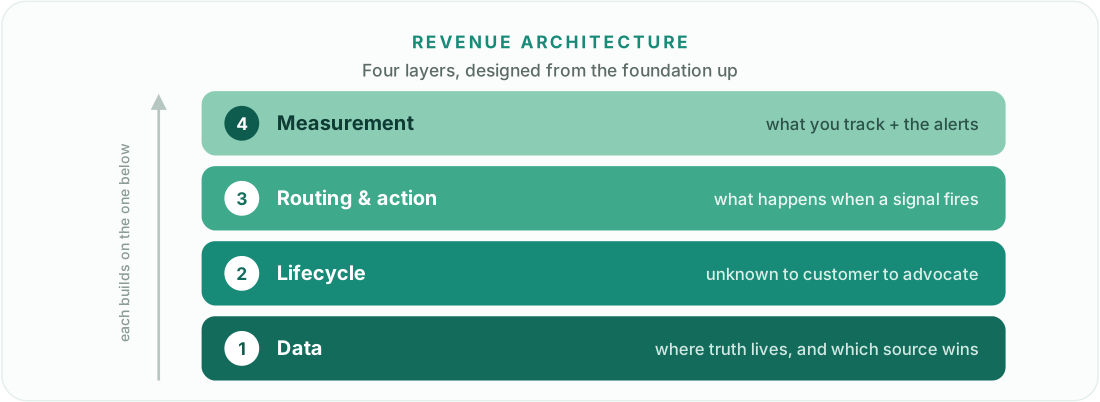
Think of it as four questions, answered in sequence. Each layer builds on the one below it, and gaps in any layer create problems that cascade upward. Most companies start by trying to fix their measurement layer (better dashboards, better reports) when the real issue is two layers down in how their data flows or how their lifecycle stages are defined.
Where does truth live? In most companies, the CRM is the de facto source of truth. But the CRM was designed for salespeople to log activities, not for revenue teams to make decisions. Revenue architecture asks: what data do we need, where should it live, and how does it flow between systems?
For enterprise B2B SaaS, this typically means the CRM is one system of many. Enrichment data lives in Clay. Intent signals come from multiple providers. Product usage data lives in a data warehouse. The architecture defines how these sources connect and which system wins when data conflicts.
In practice, this means designing a data hierarchy. We typically build it like this: Clay sits at the top of the funnel as the enrichment and verification layer, feeding clean, validated records into HubSpot as the operational CRM. Intent signals from providers feed into the orchestration layer rather than directly into the CRM, because raw intent data without context creates more noise than signal. Product usage data stays in the data warehouse and gets surfaced to the CRM only when it triggers a meaningful threshold, such as a usage spike that indicates expansion readiness or a drop that signals churn risk.
The architecture decision that matters most at this layer is conflict resolution. When Clay says a company has 500 employees and the CRM says 200, which one wins? When an intent provider flags an account as high-intent but the product usage data shows declining engagement, what does the system do? These are architectural questions, not operational ones. Get them wrong and every downstream layer inherits the confusion.
How does a buyer move from unknown to customer to advocate? The bowtie model recognises that revenue doesn't end at closed-won. The post-sale journey (onboarding, adoption, expansion, advocacy) is where recurring revenue compounds.
Revenue architecture defines the stages, the criteria for moving between them, and the signals that indicate progression or risk. For enterprise SaaS with complex buying committees, this means multi-threaded lifecycle tracking (not just one contact per deal, but the full buying group's engagement mapped across stages).
For enterprise SaaS, the lifecycle layer has to account for something most mid-market models ignore: the buying committee. A single contact moving through stages doesn't represent what is actually happening in an enterprise deal. The architecture needs to track engagement across the full buying group and define stage progression based on collective signals, not individual ones. Selection isn't when one champion says they're interested. It's when three stakeholders from different functions have engaged with your content, attended a call, or responded to outreach within a compressed timeframe.
We build this using HubSpot's association labels and custom properties that track buying group composition, engagement depth per contact, and a composite deal health score that weights multi-threading above single-thread momentum. The architecture defines what "healthy" looks like at each stage, so the system can flag deals that are advancing on paper but structurally weak because they only have one active thread.
When a signal fires, what happens? Revenue architecture defines the logic: if intent signal detected and account fits ICP and no active opportunity exists, then route to named account rep with full context. If existing customer shows churn risk signals, then alert CSM and trigger retention playbook.
This is where architecture meets automation. But the architecture comes first. You design the logic, then you implement it in HubSpot workflows, Clay tables, or orchestration platforms. Most teams do it backwards: they build workflows without designing the logic that should govern them.
The routing layer is where most RevOps teams spend their time, but without the data and lifecycle layers designed properly, routing logic becomes increasingly brittle. We have audited CRM instances with 200+ workflows where nobody could explain which ones were active, which were redundant, and which were actively contradicting each other. That isn't an operational problem. That's an architecture problem. The routing logic was never designed. It was accumulated.
A properly architected routing layer starts with a signal taxonomy: what signals exist, what priority they carry, and what action each one triggers. High-intent signals (pricing page visits, competitor comparison searches, direct outreach) get immediate routing to named account reps with full context packages built automatically by the system. Medium-intent signals (content downloads, webinar attendance, job postings that indicate growth) get queued for next-day review with enriched profiles. Low-intent signals get logged for pattern recognition but don't trigger outbound action. The taxonomy is documented, reviewed quarterly, and updated based on what actually correlates with closed-won deals.
What do we measure and why? Revenue architecture defines the metrics that matter at each stage. The primary metric: deal velocity (how fast does revenue move through the system). Supporting metrics: conversion rates between stages, time-in-stage, signal-to-action latency, expansion revenue ratio.
Critically, measurement is designed into the architecture from the start, not bolted on afterwards. Every lifecycle stage has an entry criterion, an exit criterion, and a time benchmark. This makes reporting automatic rather than manual.
The measurement layer is also where you build early warning systems. A deal that has been in the selection stage for longer than 1.5x the average time-in-stage for its segment isn't just slow. It's statistically likely to be stuck. The architecture defines what "stuck" means, the thresholds that trigger alerts, and the playbook that activates when a deal crosses those thresholds. This isn't something you configure after the fact. It's designed into the system from the start.
We track a metric we call signal-to-action latency: the time between a meaningful signal firing and the first human action taken in response. For most companies we audit, this number is measured in days. For companies running architected systems, it's measured in minutes. That difference isn't marginal. It's the difference between reaching a buyer while they're actively evaluating and reaching them after they have already made a shortlist.
Revenue architecture matters for every B2B company, but it's critical for enterprise SaaS because of three structural characteristics:
Enterprise deals involve 6-10 decision-makers across multiple functions. A CRM that tracks one "contact" per deal fundamentally can't model how these committees form, who influences whom, and where consensus is building or stalling. Revenue architecture for enterprise must be multi-threaded by design.
When deals take 3-9 months, the system must maintain context across dozens of interactions, track signal changes over time, and surface deals that are stalling before they go dark. This requires architectural decisions about what data to capture, how to weight recent vs historical signals, and how to alert reps to changes in buyer behaviour.
For enterprise SaaS, net revenue retention is the single most important metric. This means the post-sale architecture (onboarding workflows, health scoring, expansion signal detection, CSM routing) needs the same rigour as the pre-sale architecture. Most companies design the pre-sale motion carefully and then improvise everything after closed-won.
The bowtie model expands the traditional funnel into a full lifecycle. The left side covers acquisition (Awareness, Education, Selection, Commitment). The right side covers expansion (Onboarding, Adoption, Expansion, Advocacy). The "knot" in the middle is the moment of commitment (closed-won).
Most revenue architecture focuses almost exclusively on the left side. GTM Layer's approach treats both sides with equal architectural rigour because for enterprise SaaS, the right side generates more revenue over the customer lifetime than the left side.
In practice, this means:
These terms get used interchangeably but they're not the same thing.
Revenue architecture is the design: what should the system look like, how should data flow, what logic governs decisions, what metrics matter.
RevOps is the operation: keeping the system running, maintaining data quality, building reports, training users, iterating on processes.
You need architecture before you can do RevOps well. Most companies hire RevOps people and ask them to operate a system that was never properly designed. The result is endless firefighting: fixing data issues that stem from architectural gaps, building reports that measure the wrong things because lifecycle stages are poorly defined, routing leads through logic that nobody documented.
GTM Layer's approach: design the architecture first (revenue architecture engagement), then operate it (fractional RevOps leadership). The architecture creates the blueprint. RevOps executes against it.
After auditing 60+ CRM implementations, the same architectural failures appear consistently. Understanding these patterns helps you diagnose whether your current system has structural issues that operational fixes can't solve.
Treating the CRM as the data layer. The CRM is an operational tool, not a data platform. When companies try to make HubSpot or Salesforce the single source of truth for everything, they end up with bloated objects, slow page loads, unreliable reporting, and sales teams who stop trusting the data. The CRM should hold the operational data that reps and managers need to act. Enrichment data, intent signals, and historical analytics belong in purpose-built systems that feed the CRM only what it needs.
Building lifecycle stages around internal process instead of buyer behaviour. Stages like "Qualified by SDR" and "Demo Completed" describe what your team did, not where the buyer is in their decision process. Revenue architecture defines stages based on buyer behaviour and commitment signals. Did the buyer articulate a problem? Have they confirmed budget exists? Are multiple stakeholders engaged? These are buyer-centric criteria that produce accurate forecasting. Activity-based stages produce pipeline that looks full but converts poorly.
Automating before architecting. The most common pattern: a new RevOps hire builds 30 workflows in their first month to prove value. Six months later, nobody knows what triggers what, workflows conflict with each other, and the system has become too fragile to change. Architecture first, automation second. Define the logic on paper before you build it in the CRM. Document what each workflow does, what triggers it, and what it depends on. Then build it in a way that can be maintained by someone who didn't create it.
Ignoring the post-sale architecture entirely. Companies invest weeks designing their pre-sale motion and then hand customers to a CSM with no structured onboarding workflow, no health scoring, no expansion signal detection, and no automated renewal process. For enterprise SaaS where net revenue retention is the most important growth metric, this is like building half a bridge. The post-sale architecture needs the same rigour as pre-sale: defined stages, measurable transitions, automated alerts, and clear ownership at every point.
Designing for today's team instead of next year's. Revenue architecture should outlast the people who built it. If your system requires specific individuals to interpret data, make routing decisions, or explain how things work, it isn't architected. It's improvised. Good architecture is documented, logical, and learnable by a new team member within a week. Institutional knowledge should live in the system, not in people's heads.
Five questions that reveal whether you have revenue architecture or just a CRM configuration:
1. Can you explain your lifecycle stages and the criteria for each transition? If the answer involves phrases like "sales moves them when they feel ready" or "it depends on the rep", you have no architecture. Stage definitions should be objective, measurable, and consistent regardless of which rep is working the deal.
2. When a high-intent signal fires, does something happen automatically? If signals require manual interpretation and action, your system isn't architected. Revenue architecture means signals trigger actions: routing, alerts, playbooks, sequences. The human adds context and judgement, not the initial response.
3. Do you know your average time-in-stage for every lifecycle transition? If you can't answer "how long does a typical deal spend in evaluation before moving to selection?", you're not measuring what matters. Revenue architecture includes measurement by design.
4. Is your post-sale motion as rigorous as your pre-sale motion? If onboarding is ad hoc, health scoring doesn't exist, and expansion is purely relationship-driven, you have half an architecture. The right side of the bowtie needs the same design rigour.
5. Could a new team member understand your revenue system in a week? If it takes months for a new hire to understand how everything works, the architecture exists only in people's heads. Documented architecture is real architecture. Everything else is institutional memory waiting to walk out the door.
Deal velocity is the primary outcome metric for revenue architecture. It measures how fast revenue moves through the system, and you can put numbers to it with our free pipeline velocity calculator:
Deal Velocity = (Number of Opportunities x Average Deal Value x Win Rate) / Average Sales Cycle Length
Revenue architecture improves deal velocity by:
Every architectural decision should be evaluated against its impact on deal velocity. If a proposed change doesn't make revenue move faster through the system, question whether it's worth the complexity.
Revenue architecture is best built incrementally. Each phase delivers standalone value while creating the foundation for the next. Here is the approach we use with enterprise SaaS clients.
Phase 1: Discovery and audit (weeks 1-2). Map the current state. Every tool, every workflow, every data flow. Interview stakeholders across sales, marketing, and customer success to understand what is working, what is broken, and where the biggest friction points are. The output is a signal map: where buyer signals exist, where they're getting lost, and where they should be going. This isn't a technology audit. It's a systems audit. The question isn't "is HubSpot configured correctly?" The question is "is the overall system designed to produce the outcomes you need?"
Phase 2: Architecture design (weeks 3-4). Design the four layers. Define lifecycle stages with objective entry and exit criteria. Build the signal taxonomy. Design routing logic. Establish the measurement framework. Everything is documented before anything is built. The architecture document becomes the blueprint that all future work references. It answers: what data goes where, what triggers what, who owns what, and how we know if it's working.
Phase 3: Data layer implementation (weeks 5-6). Set up the enrichment infrastructure. Build Clay tables with waterfall enrichment that caches results. Configure data flows between enrichment providers, the CRM, and any supporting systems. Establish conflict resolution rules. Validate data quality with sample sets before going live. This phase often reveals issues that were invisible before: duplicate records, inconsistent naming conventions, fields that exist in the CRM but are never populated, and data that's technically present but practically useless because it's outdated.
Phase 4: Lifecycle and routing implementation (weeks 7-8). Configure lifecycle stages in the CRM with automation that enforces transition criteria. Build the routing logic based on the signal taxonomy. Set up automated alert systems for stalled deals, high-intent signals, and post-sale health indicators. Test with real data to validate that signals trigger the correct actions and that routing decisions match the designed logic.
Phase 5: Measurement and iteration (weeks 9-12). Deploy the measurement framework. Build dashboards that track the metrics defined in the architecture. Set up weekly review cadences to evaluate system performance. Identify gaps between designed behaviour and actual behaviour. Iterate on the architecture based on what the data reveals. This phase never truly ends. Revenue architecture is a living system that evolves as the business scales and the market changes.
Data (where truth lives and how it flows), lifecycle (how buyers move from unknown to customer to advocate), routing and action (what happens when a signal fires), and measurement (what you track and the thresholds that trigger alerts). They are designed in sequence, because each layer depends on the one beneath it. Gaps low down cascade upward, which is why fixing dashboards rarely fixes a reporting problem that actually starts in the data layer.
The design phase (mapping lifecycle, defining signals, designing routing logic, establishing metrics) takes 3-4 weeks for a focused engagement. Implementation takes another 4-8 weeks depending on complexity and the current state of the tech stack. Total: 2-3 months from kickoff to a fully operational revenue architecture.
Almost never. Revenue architecture is about how you configure and connect your existing tools, not replacing them. HubSpot, Salesforce, or any modern CRM can support good revenue architecture. The issue is usually how the CRM is configured, not which CRM you're using.
A CRM audit checks whether your current configuration is working correctly. Revenue architecture asks whether your current configuration is the right design in the first place. An audit fixes execution problems. Architecture fixes design problems. Often you need both, but architecture comes first.
Ideally, a senior RevOps or GTM leader with strategic authority (not just operational authority). They need the ability to make decisions that affect sales, marketing, and customer success simultaneously. If that role doesn't exist internally, this is where fractional RevOps leadership fills the gap.
Revenue architecture defines how every tool in your stack connects and what role each plays. The CRM handles pipeline and activity logging. The enrichment layer (Clay) provides data intelligence. The orchestration layer triggers actions. The data warehouse stores history. Architecture is the blueprint that tells each system what it's responsible for and how it communicates with the others.
Incremental is almost always better. Start with the lifecycle layer (define stages and criteria), then build the signal layer, then routing, then measurement. Each layer delivers value independently. A phased approach over 2-3 months works better than a 6-month waterfall project that tries to redesign everything at once.

%20(1).jpeg)