.png)

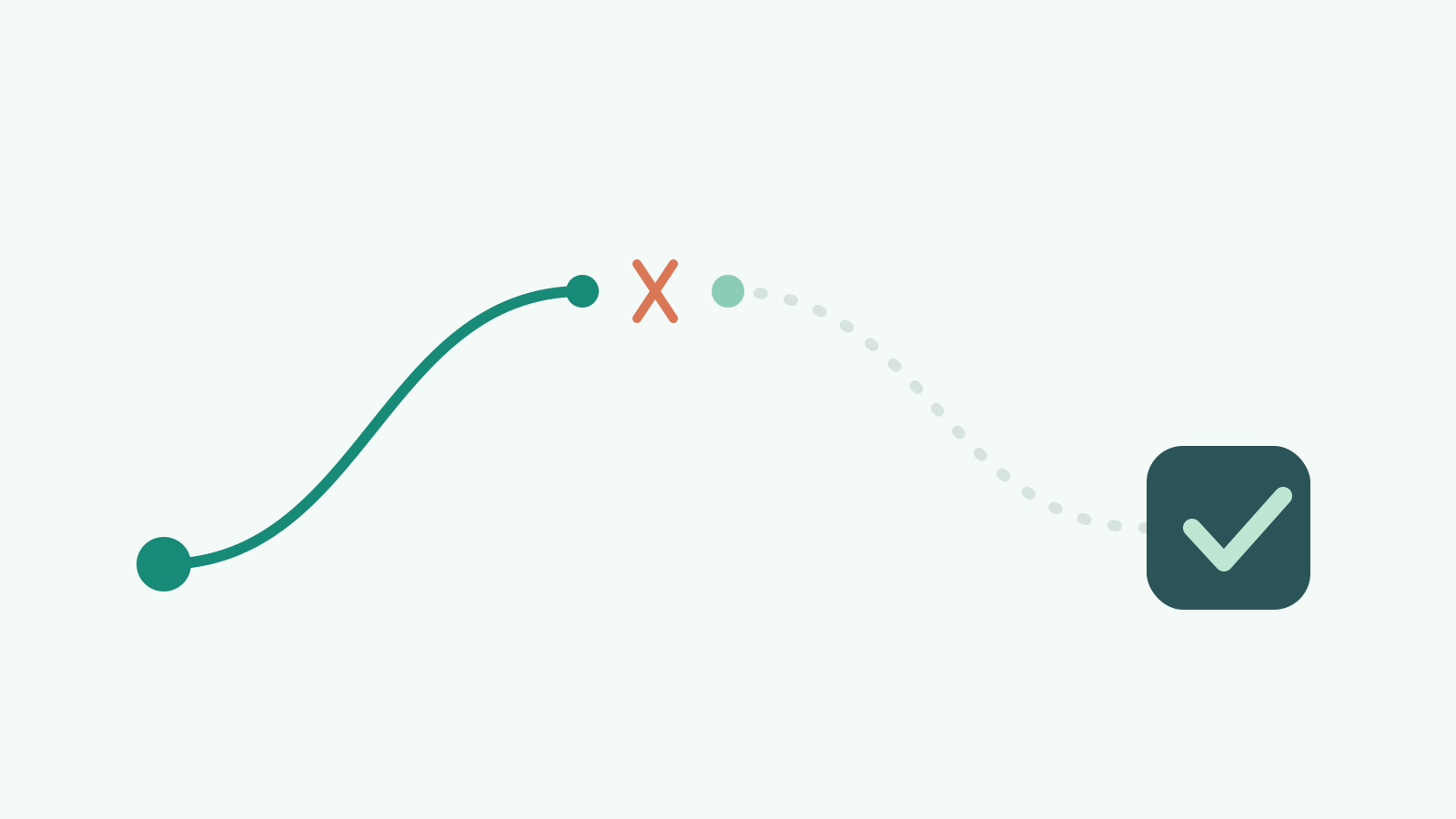
Direct answer: sales signal loss is what happens when a buying signal fires but never turns into a rep doing something about it. To fix it, you trace a signal end to end and find the exact point it dies. There are six places it usually leaks: it never gets captured, it gets captured but not scored, it gets scored but no next move is decided, the move is decided but surfaced where the rep never looks, the rep sees it but does not trust it, or the outcome is never recorded so the system never learns. Walk three real accounts through those six stages, mark where each one drops, and you have your leak. Most teams lose signal in the middle three, between scoring and the rep, not at capture. The fix is almost never another data source. It is closing the gap between a signal firing and a rep knowing the right thing to do about it.
The rest of this guide gives you the checklist to find your own leaks, the six stages a signal has to survive, and how to close each one. This is the work we do for clients, so it is also the clearest description of the problem the intelligence layer exists to fix: the layer between your tools and your revenue, turning account context into the rep's next move instead of another alert nobody acts on.
Published 17 July 2026. Reviewed quarterly.
Sales signal loss is the gap between a buying signal firing and a rep acting on it. The signal exists. You probably paid to source it. And then nothing happens, because somewhere between the event and the rep's day, the thread got dropped.
It is the single most common revenue leak I find, and it is almost invisible, because nothing is technically broken. The intent platform fired. Clay enriched the account. The dashboard updated. Every tool did its job. The deal still did not move, because no human ever did the one thing the signal called for. You cannot find this in a data-cleanliness review. The data is fine. The decision just never got made.
I call the distance between a signal firing and a rep knowing what to do about it the context gap. Signal loss is what it costs you. The good news is that once you know it is a flow problem and not a data problem, it is findable and fixable, and you do not need a single new tool to start.
Because the tools solve the easy part. Sourcing signal is mostly a tooling problem and it is mostly solved. You can buy intent data, wire up Clay, pull product-usage events, transcribe every call. None of that is hard any more.
What the tools do not do is decide. They will not tell a rep that this specific signal, on this specific account, means reach the new economic buyer about the thing that just changed, and not send another nurture email. That is a thinking problem, and it is the part nobody sells you off the shelf. So teams buy the capture layer, assume the action will follow, and it never does. The signal fires into a void.
The other reason is that signal loss hides. A blocked pipeline you can see. A leaking signal looks like a quiet account that just did not convert. You do not get an error message when a rep ignores an intent spike. You get a slightly worse quarter and no idea why.
A signal has to survive six stages to become revenue. It can die at any one of them. Here is the path, and what failure looks like at each step.
1. Capture. The signal fires somewhere but never makes it into a system anyone uses. The classic version: a champion you knew well changes jobs to a company in your ICP, and nobody is watching your old contacts for job moves, so you never even know. Capture failures are the only ones that are genuinely a tooling problem, and they are the minority.
2. Scoring. The signal is captured but treated as just another row. Everything gets the same flat weight, so an anonymous topic surge and a champion job change look identical. The rep cannot tell what matters, so they trust none of it. A signal with no relative weight is noise with a timestamp.
3. Deciding the next move. The signal is captured and even weighted, but nobody has defined what to actually do about it. The system says "intent spike on Acme" and stops. The rep is left to work out what changed, what it means, and what to do, on top of the forty other things they are doing. Most of the time they do nothing, because deciding is work and the system handed them homework instead of an action.
4. Surfacing it where the rep works. The move is decided, but it lives in a separate signals dashboard nobody opens. If it is not in the CRM, in the flow of the rep's normal day, it does not exist as far as the rep is concerned. You have built a museum, not a system.
5. Rep trust. The rep sees the move but does not believe it. This is what you get when you have burned them before with weak signals, or when the move arrives with no reason attached. "Reach out to Acme" with no "because" is easy to ignore. A rep who has chased three bad alerts will ignore the fourth, even if the fourth is the good one.
6. The feedback loop. The rep acts, but nobody records what happened. So the scoring never gets sharper. You run the same blunt rules forever, the system never learns which signals actually convert, and the same weak signals keep interrupting the same reps. No loop means no compounding.
The thing worth sitting with: stages two through five are all in the middle, between capture and the rep, and that is where almost everyone leaks. Teams pour money into stage one and stage six gets ignored entirely. The expensive losses are in the boring middle.
Steal this. You can run it yourself in an afternoon with nothing but your CRM and a bit of honesty. Pick three to five real accounts that recently fired a clear signal and went nowhere, and walk each one through these checks.
The output is a single sentence per account: "This signal died at scoring because everything is weighted +10." Once you have five of those, the pattern is usually embarrassingly obvious, and it is almost always in the middle three stages.
If I had to name the most common single cause across the stacks I have seen, it is this: the system surfaces the signal instead of the action. Telling a rep "intent spike on Acme" feels like signal-based selling. It is not. It is offloading the hardest part of the job, working out what to do, onto the busiest person in the building.
The signal is the raw event. The action is the one specific next move that event earns on that account, with the reason attached. Most teams ship the first and call it done. The rep gets a notification, has no idea what changed or what to do, and carries on with the sequence they were already running. The signal cost money and produced nothing.
Close that one gap, hand over the move and the "because" rather than the raw event, and you fix more signal loss than any new data source ever will. It is also the cheapest fix, because the signal is already there. You are not buying anything. You are deciding something.
Match the fix to the stage. You do not fix signal loss in general, you fix it where your accounts are actually dropping.
You do not have to fix all six at once. You almost never should. Find your primary leak with the checklist, close that one, watch what changes, then move to the next.
A rep opens the CRM and on the account they are working sees three things: what changed (the signal), why it matters (the gap it fills in the deal), and the one thing to do about it (the next move), with the reasoning attached so they trust it. They do the move. The outcome gets logged. The scoring quietly adjusts. Next time, the system is a little sharper about what that kind of signal is worth on that kind of account.
That is the intelligence layer doing its job. It pulls account context together, reasons over it through a real sales method, surfaces the next move where the rep works, and learns from what happens. The stack you already own stops being a place signals go to die and starts deciding what happens next.
The honest version: most teams are leaking at two or three of these stages right now, not all six, and they have never traced a single signal end to end to find out which. That is the whole job. Trace three accounts, mark where they drop, fix the most common drop. You will learn more about your revenue engine in an afternoon than a dashboard will tell you in a year.
You can run the checklist above yourself, and you should. But here is the honest bit: finding the leak is the easy part. Most real fixes are not "add this field" or "tweak this score". They are "the context to decide this is scattered across six tools and nobody is assembling it into a next move". That is a system to build, not a box to tick.
That is what our free Revenue Leak Scan does. We run this on your real accounts and show you exactly where signal is being lost between firing and a rep acting, stage by stage. It is free and CRM-only, and you keep the findings either way. If you would rather run the checklist yourself first, genuinely, do that. The teams that get the most out of the Scan are the ones who already tried and hit the wall where it stops being a checklist and starts being a build.
This guide is one of three on the same problem. If you want the wider sweep of where revenue leaks across the whole CRM, read how to run a CRM revenue audit in 2026. If you want the mechanics of scoring a signal and deciding the next move, read how to turn buying signals into sales actions.
Sales signal loss is when a buying signal fires but never turns into a rep acting on it. The event happens, the tools record it, and then nothing changes in the rep's day, because somewhere between the signal firing and the rep's work the thread got dropped. It is hard to spot because nothing is technically broken: the data is fine, the decision just never got made.
In the middle, between capture and the rep, not at capture itself. A signal has to survive six stages: capture, scoring, deciding the next move, surfacing it where the rep works, the rep trusting it, and recording the outcome. Most teams over-invest in capture and lose signal at scoring, deciding the move, or surfacing. The cheapest fixes are usually in those middle stages.
Pick three to five accounts that fired a clear signal and went nowhere, then walk each one through the six stages and mark exactly where it dropped. Write a one-line cause for each account, then count where most of them die. That pattern is your primary leak. You can do this in an afternoon with just your CRM.
Surfacing the signal instead of the action. Telling a rep "intent spike on Acme" hands them the raw event and leaves them to work out what to do, on top of everything else they are juggling. Hand over the specific next move and the reason instead, and you close more signal loss than any new data source will, at no extra cost because the signal is already there.
Almost never. Capture is the only stage that is a genuine tooling problem, and it is usually the minority of your losses. The expensive leaks are in scoring, deciding the next move, surfacing it in the CRM, and rep trust, all of which are decisions and process, not data sources. The fix is closing the gap between a signal firing and a rep knowing what to do, not buying another feed.
A data problem is something you can see: a blank field, a duplicate, a deal with no close date. Signal loss is invisible, because every tool did its job and the data looks fine. The signal fired, the system recorded it, and a human simply never acted. A data-cleanliness review will never catch it. You have to trace real signals end to end to find it.
Run the full trace once a quarter, or any time your motion changes (new segment, new product, a reorg), because that is when new leaks open up. Between those, a quick check on your top signal types, are they being captured, scored, surfaced and acted on, takes a few minutes and stops a leak from running for a whole quarter unnoticed.

%20(1).jpeg)