.png)


There is a lot of noise about AI in B2B right now. Every tool has an AI feature. Every vendor claims their AI will transform your pipeline. Every conference has a track on "AI-powered revenue operations." Most of it is marketing. Some of it is real. Here is what actually works in practice, based on running AI across revenue operations for multiple B2B teams over the past year.
The short version: AI is excellent at operational overhead, good at data analysis, decent at first drafts, and terrible at anything requiring relationship judgement. If you set expectations correctly, the ROI is significant. If you expect it to replace your sales team, you will be disappointed.
This is the single highest-ROI application of AI in revenue operations today. Not because the AI itself is doing the enrichment (Clay, Clearbit, Apollo handle the actual lookups), but because AI agents can orchestrate the enrichment workflow intelligently.
An AI agent can look at your CRM, identify contacts missing key data points, check your enrichment cache for existing data, trigger fresh lookups only where needed, and write the results back to the right records. It can also run data hygiene passes: flagging duplicate contacts, identifying stale records, normalising job titles, and catching data that does not match known patterns.
The key insight is that this work is high-volume, repetitive, and context-dependent. Perfect for AI. A human doing enrichment audits manually would take days for what an agent does in hours.
AI is genuinely good at looking at your pipeline data and surfacing patterns humans miss. Not because humans cannot see the patterns, but because humans do not have the patience to look at every deal, every stage transition, every velocity metric, every day.
An agent connected to your CRM via MCP can run a daily pipeline review: which deals have been in the same stage too long, which have activity gaps, which are at risk based on historical patterns, and where coverage is thin. It can compare this week's pipeline to last week's and tell you exactly what changed and why.
This is not predictive AI (which mostly does not work for small B2B teams with limited data). This is pattern recognition against your own data. It is more like having an analyst who reviews every deal every morning and writes you a briefing.
Before a client call, an agent can pull together everything relevant: the contact's enrichment data, recent deal activity, open issues in the project tracker, notes from the last meeting, any emails exchanged since. Instead of spending 10 minutes pulling context from four different tools, you get a pre-call brief in your inbox.
After the call, the meeting recorder generates a transcript. An agent extracts action items, creates tasks, and updates the deal notes. The gap between "we agreed to do this" and "it is tracked somewhere" shrinks from days to minutes.
Email sequences, proposal outlines, SOW templates, follow-up emails after calls. AI generates solid first drafts of all of these. The key word is "first drafts." You still need a human to review, adjust the tone for the specific client, and add the nuance that comes from actually knowing the person.
Where this saves real time: email sequences for outbound campaigns. Writing 5-7 personalised email variants per segment used to take half a day. An agent can generate the first drafts in minutes, and the human editing pass takes an hour instead of four.
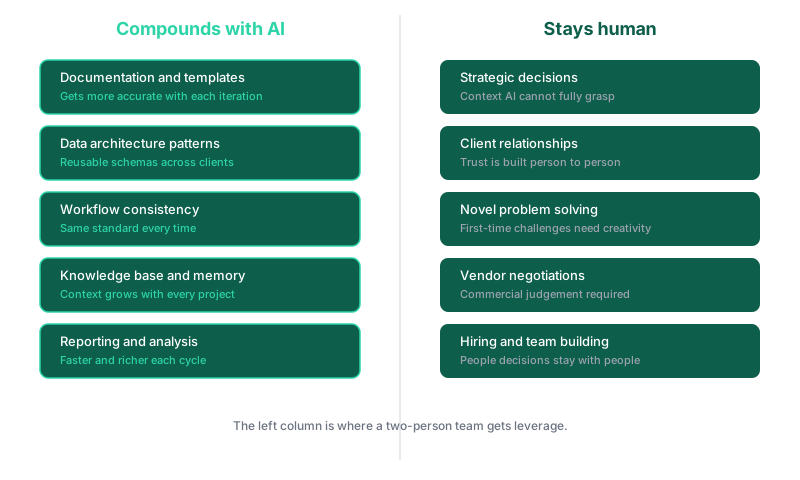
Status updates, task creation, documentation maintenance, system sync. Everything described in the AI agents running a consultancy post. This is the category where AI delivers the most consistent value because the work is entirely operational and repeatable.
AI can score leads against your ICP criteria faster than a human. It can pull enrichment data, check technographic signals, compare against your closed-won customer profile, and assign a score. This works.
What does not work as well: using AI scoring as the sole input for routing decisions. The scores are only as good as the data and the criteria. If your ICP definition is vague ("mid-market SaaS companies"), the AI will score too broadly. If your enrichment data is incomplete, the scores will have gaps. Use AI scoring as one input alongside human judgement, not as a replacement for it.
AI can personalise outbound emails based on enrichment data: referencing the prospect's tech stack, recent funding, company size, industry. This works better than generic templates. It does not work as well as a human who actually researched the prospect and found a genuine reason to reach out.
The honest take: AI personalisation gets you from "terrible generic email" to "decent personalised email." It does not get you to "this person clearly did their homework." For high-value prospects, the human touch still matters. For volume outbound, AI personalisation is the right trade-off.
AI can analyse call recordings and identify patterns: which objections come up most, which talk tracks correlate with progression, where deals tend to stall in the conversation. This is valuable for coaching and process improvement.
Where it falls short: real-time call coaching. The technology exists but the latency and context limitations mean the suggestions are often either obvious ("ask about their timeline") or wrong ("the prospect just mentioned a competitor" when they actually mentioned a partner). Give it another year.
The idea that an AI agent could manage deals end-to-end, deciding when to follow up, what to say, when to escalate, when to discount. This does not work for B2B sales. B2B deals involve multiple stakeholders, complex buying processes, and relationship dynamics that AI cannot read. An agent can surface the data and flag risks. It cannot navigate the politics of a six-person buying committee.
AI-powered forecast models need large datasets to work well. If you close 20 deals per quarter, there is not enough data for a model to identify reliable patterns. The AI will overfit to noise and give you confident predictions that are wrong.
For small teams, a simple weighted pipeline with stage-based probabilities (adjusted based on your actual conversion rates) outperforms any AI forecast model. Save the AI forecasting for when you have hundreds of deals per quarter.
Despite what some vendors claim, AI cannot replace the SDR function for most B2B teams. It can handle parts of the role: initial research, first-draft emails, meeting scheduling. But the actual qualification conversation, the persistence through a multi-touch sequence, the ability to read a prospect's tone and adjust, that is still human work.
What AI can do is make each SDR significantly more productive. An SDR supported by AI agents for research, drafting, and data entry can handle 2-3x the volume. But zero SDRs plus AI does not equal a functioning outbound motion.
The test is simple: does this tool reduce operational overhead, or does it claim to replace human judgement?
Tools that reduce overhead (enrichment orchestration, pipeline analysis, meeting prep, task automation) deliver consistent ROI because the value proposition is clear and measurable. You were spending X hours on this. Now you spend Y hours. The difference is the value.
Tools that claim to replace judgement (autonomous deal management, AI SDRs, predictive forecasting for small teams) usually disappoint because they are solving a problem that requires capabilities AI does not have yet.
The practical approach: start with the operational overhead. Build your AI-first operations stack with an operational data store, connect your tools via MCP, and let agents handle the repeatable work. That is where the ROI is today. The judgement-replacement tools will improve over time, but you do not need to wait for them to get significant value from AI in your revenue operations.
This post is part of a series on building AI-first operations. Related: How AI Agents Run a Two-Person RevOps Consultancy, Why Most AI Implementations Fail (and What to Do Differently).

%20(1).jpeg)