.png)


Most AI implementations in B2B operations fail. Not dramatically. They do not crash and burn in a spectacular way. They just quietly stop being used. Someone buys an AI tool, runs a few experiments, gets mediocre results, and the team goes back to doing things manually. The subscription keeps charging. Nobody cancels it because cancelling feels like admitting failure. So the tool just sits there, unused, costing money.
I have seen this pattern in dozens of teams. The failure is rarely the AI's fault. It is almost always a setup problem.
Here are the most common reasons AI implementations fail in B2B operations, and what actually works instead.
The most common mistake is picking a use case that sounds impressive instead of one that solves an actual pain point.
"We are going to use AI to predict which deals will close." That sounds great in a board presentation. In practice, your team closes 15 deals per quarter and the AI has no statistical basis for predictions. It gives you confident numbers that are wrong, and your team loses trust in the tool within a month.
Compare that to: "We are going to use AI to create tasks from meeting transcripts." Not impressive-sounding at all. Entirely operational. And it saves the team 30 minutes per meeting, every meeting, starting on day one. The ROI is immediate, measurable, and undeniable.
The pattern: successful AI implementations start with operational overhead, not strategic intelligence. Start with the boring, repetitive work that everyone hates doing. Meeting follow-ups, data entry, status updates, documentation maintenance. These have clear before-and-after metrics, they deliver value immediately, and they build trust in AI across the team.
Once the team trusts that AI handles operational tasks reliably, you can expand to more complex use cases. But if you start with the complex use case, you never build that trust.
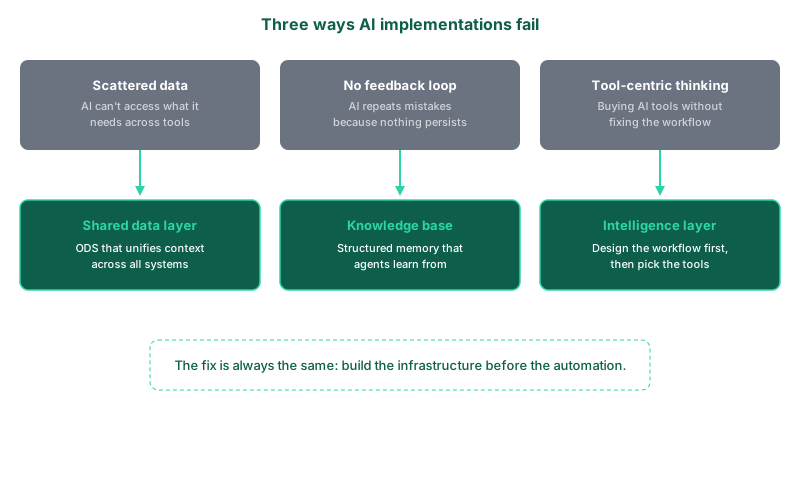
AI is only as good as the data it can access. If your data is scattered across disconnected tools with no shared layer, the AI has nothing to work with.
This is the most frustrating failure because it is invisible at the buying stage. The vendor demo looks amazing because they are using clean, connected demo data. Your reality is a CRM with 40% missing fields, an enrichment tool that does not sync back to the CRM, and a project tracker that nobody updates consistently.
You plug in the AI tool and it surfaces insights like "deal X is at risk." Why? "The contact has not responded in 14 days." But the contact responded by phone last week and nobody logged it. The AI is technically correct based on the data, but practically wrong based on reality. Trust evaporates.
The fix is building the data foundation first. An operational data store that centralises your operational data. An enrichment cache that keeps your company and contact data current. Clean CRM hygiene with consistent data entry processes. You do not need perfect data (you will never have perfect data), but you need data that is good enough for the AI to reach useful conclusions.
This is why the AI-first operations guide starts with the data layer, not the intelligence layer. Without the data foundation, everything you build on top is unreliable.
Most teams buy AI as a product. They sign up for an AI tool, configure it, and expect it to work. When it does not work perfectly out of the box, they blame the tool and move on to the next one.
AI that works well in operations is infrastructure, not product. It needs to be connected to your specific tools, trained on your specific context, and configured for your specific workflows. An off-the-shelf AI sales tool does not know your deal stages, your ICP criteria, your enrichment providers, or your documentation structure. It makes generic suggestions based on generic patterns.
What works: building an AI layer that connects to your existing tools via standardised protocols like MCP. The AI reads your documentation to understand your context. It queries your database for your data. It creates tasks in your project tracker using your structure. It is not a separate product. It is a layer that sits across your entire stack.
This takes more setup time than buying a product. But the result is an AI that actually understands your business, not a generic tool that gives generic advice.
Some teams go too far in the other direction: they try to automate everything. The AI scores leads, routes them, writes the outreach, and follows up. No human touches the process until a meeting is booked.
This fails because B2B operations is full of edge cases that require judgement. The lead who matches your ICP perfectly but works at a company you just had a bad experience with. The contact who changed jobs and now looks like a new lead but is actually an existing relationship. The deal that needs a creative pricing structure to close.
Successful AI implementations have clear boundaries. The AI handles the repeatable work: data enrichment, task creation, status updates, reporting. Humans handle the judgement calls: prioritisation, relationship decisions, creative problem-solving, scope changes.
The design principle: the AI should surface options and recommendations, not make decisions. "Here are three deals at risk and why" is useful. "I have automatically deprioritised these three deals" is dangerous. Keep humans in the loop for anything with consequences.
Teams measure AI success by the wrong metrics. "How many insights did the AI generate?" "How accurate are the predictions?" "How many tasks did it automate?"
None of these matter if the team is not actually using the AI's output. The right metric is always: did this save time or improve a decision that a human was previously making?
Practical metrics that actually indicate success:
Time saved per task. How long did meeting follow-ups take before? How long do they take now? The delta is the value. If the AI generates meeting tasks but a human still has to review and fix them, measure the total time including review, not just the generation time.
Adoption rate. What percentage of the team is using the AI tool weekly? If it is below 50% after the first month, something is wrong. Either the tool is not solving a real problem, or the friction to use it is too high.
Error rate. How often does the AI produce output that needs significant human correction? An acceptable error rate depends on the task. For status updates, 10% needing minor edits is fine. For deal stage recommendations, even 5% errors will destroy trust.
Workflow integration. Is the AI embedded in existing workflows, or does it require a separate step? If someone has to open a different tool, copy data in, and copy results out, adoption will drop regardless of output quality.
The common thread across all five failures: treating AI as a magic solution rather than an operational tool that requires the same infrastructure, process design, and change management as any other system.
The approach that works:
Start with infrastructure. Build the data layer first. Get an operational data store running, connect your tools, and clean up your data foundations. This is not exciting. It is necessary.
Pick operational use cases first. Meeting follow-ups, task creation, data enrichment, status updates. Boring, measurable, immediately valuable. Build trust before expanding scope.
Connect, do not replace. Use MCP or similar protocols to connect the AI to your existing tools rather than buying separate AI products. The AI should enhance your stack, not add another disconnected tool to it.
Design for human oversight. The AI surfaces and recommends. Humans decide and approve. Clear boundaries prevent the catastrophic errors that destroy trust.
Measure time saved, not AI output. The only metric that matters is whether humans are spending less time on operational overhead and more time on work that requires their judgement and expertise.
The teams that get this right end up with AI that feels invisible. It is not a separate thing they "use." It is just how their operations work. Meetings generate tasks automatically. Data stays current without manual effort. Documentation updates itself. The AI is the connective tissue, not the main event.
That is AI-first operations. Not AI as a feature. AI as infrastructure.
This post is part of a series on building AI-first operations. Related: AI for B2B Revenue Teams: What Actually Works in 2026, How AI Agents Run a Two-Person RevOps Consultancy.

%20(1).jpeg)