.png)

Most B2B SaaS teams already have a well-integrated stack. HubSpot connected to Clay. Slack notifications firing from deal stage changes. Zapier or Make workflows syncing data between tools. Maybe a Segment pipeline feeding product events into the CRM. The integrations work. The tools talk to each other.
And yet the operational overhead keeps growing. Every new integration is another point-to-point connection to maintain. Every workflow is rigid: it does exactly what you configured, nothing more, regardless of context. Your CRM has become the centre of a brittle web where changing one integration risks breaking three others. And your 100th Zap is not smarter than your first. The whole system scales linearly with effort but never compounds.
This is the ceiling that well-integrated stacks hit. It is also the reason most teams cannot use AI effectively. Not because AI is not good enough, but because there is no shared layer where an AI agent can see and act across the full picture. The data exists. The connections exist. But they are point-to-point pipes, not an intelligent layer.
AI-first operations is the shift past that ceiling. Not "we added ChatGPT to our workflow" or "we use Copilot for emails." Those are AI-assisted operations. They are incremental improvements bolted onto the same integration-heavy architecture. AI-first means you design the operational stack around the assumption that an AI agent will be reading, writing, and acting across every system through a shared data and context layer. The AI is not a feature inside your tools or another automation in your Zapier account. It is the connective tissue between them. This is what AI RevOps actually looks like when you restructure around it rather than bolting it onto an existing stack.
This guide walks through what that actually looks like in practice, the architecture behind it, the specific tool choices and why, and how to build it without a development team. Whether you call it GTM engineering, AI RevOps, or just "building an AI GTM stack," the principle is the same: structure your data and workflows so an AI agent can operate across them.
The typical approach to AI in a B2B team goes something like this: someone starts using ChatGPT to draft emails. Someone else uses it to summarise meeting notes. Maybe you wire it into a Zapier workflow or add a Breeze step in HubSpot. Each use case is isolated. The AI starts from zero context every single time because it has no persistent access to your operational data.
This is AI-assisted operations. You are using AI as a slightly smarter autocomplete inside a stack that was never designed for it. It does not know your stack, your clients, your terminology, or what you decided last Tuesday about that pipeline issue. It cannot look up a contact in your CRM, check the enrichment status in your data platform, and then update the project tracker in a single flow. It can only work with whatever you paste into the prompt window or whatever a rigid Zap feeds it.
AI-first is fundamentally different. It means three things:
AI is the default, not the exception. Every task starts with the AI agent unless there is a specific reason it cannot handle it (human judgement required, relationship-sensitive, novel strategic decision). The question is not "should we use AI for this?" but "is there a reason not to?"
Systems are designed for AI consumption. Documentation is structured so the agent can read and act on it. Tasks are written with enough context that the agent can work on them independently. Data is centralised in a queryable layer rather than locked inside individual SaaS tools behind separate APIs.
Compound returns replace linear returns. Each piece of work the AI does makes the next piece faster because it builds on existing context. A traditional operation gets linearly more productive as the team grows. An AI-first operation gets exponentially more productive as the knowledge base grows.
The whole thing rests on a simple principle: put a shared data layer at the centre, connect every tool to it, and let an AI agent operate across all of them.
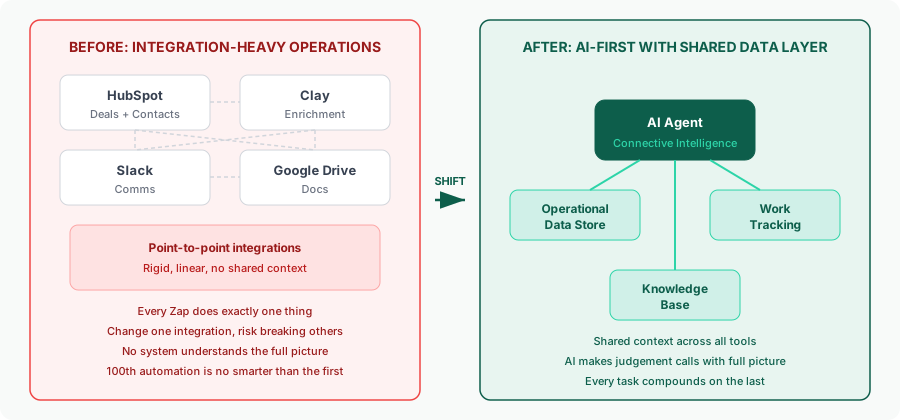
The "before" side is what most teams have. A well-connected stack held together by point-to-point integrations, each one doing exactly what it was told and nothing more. No shared context layer, no system that understands the full picture across tools.
The "after" side is four layers working together:
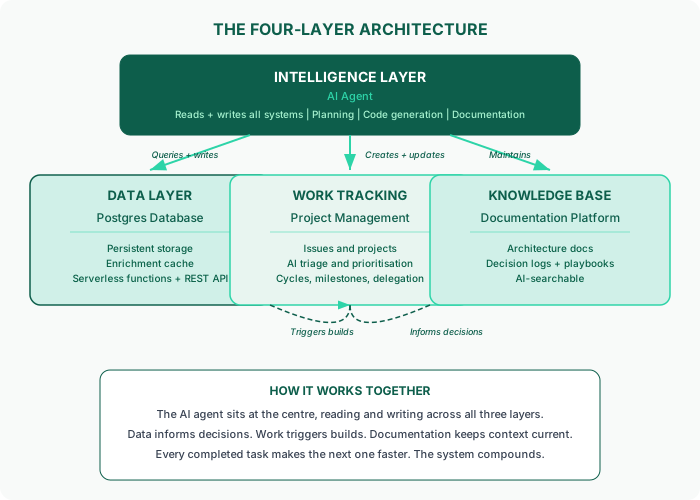
Let me walk through each layer, why it exists, and what it actually does.
Most small teams treat their CRM as the source of truth for everything. Every tool reads from and writes to HubSpot (or Salesforce, or whatever you use). This works until it does not. And it stops working faster than you think.
The problem with CRM-as-source-of-truth is threefold. Your CRM has rate limits and API costs that punish heavy integrations. Your data model is constrained by what the CRM supports (try storing enrichment cache data in HubSpot custom objects and watch your bill climb). And every tool connected to the CRM creates a brittle web of point-to-point integrations that break when one changes.
The alternative is an operational data store. A proper database (Postgres is the obvious choice) that sits underneath everything. Your enrichment cache lives there. Your unified company and contact graph lives there. Your webhook event logs live there. Your CRM reads from it and writes to it, but it is not the centre of the universe any more.
For a small team without a database administrator, a managed Postgres service is the way to go. You get a production-grade relational database with a built-in REST API, authentication, serverless functions, and storage. No server management, no DevOps overhead. It connects to your AI agent via standard protocols and to your enrichment tools via Postgres wire protocol. No middleware required.
The cost difference is real. A traditional data warehouse costs hundreds per month at even modest scale. A managed Postgres instance can run on a free or near-free tier for a small team's operational data, scaling up as you need it.
What this gives you: Every enrichment lookup is cached, so you never pay to enrich the same domain twice (this alone saves 40-60% on enrichment costs over time). Every webhook event is logged and queryable. Every tool in your stack has a single, consistent data source to work with. And your AI agent can query actual data, not just whatever you remember to paste into the prompt.
This is the part that makes everything else work. An AI agent that connects to all your tools through a standard protocol (MCP, or Model Context Protocol, is the emerging standard here) and can read, write, and act across the entire stack in a single conversation.
Not a chatbot. Not a summariser. An agent that can look at your project backlog, check the documentation, query the database, and then create a properly structured task with all the relevant context pulled from across the system.
The practical reality of running an AI agent at the centre of operations is that it replaces the operational overhead that normally requires dedicated roles. Documentation maintenance, task creation and tracking, status updates, code generation for database migrations, data analysis. These are not the high-value strategic tasks that require human judgement. They are the operational tax you pay to keep the system running. An AI agent handles them faster and more consistently than a person doing them between other work.
The key insight is that the agent compounds. Every piece of documentation you write makes the agent better at the next task. Every decision you log makes the agent smarter about your context. Every completed task teaches the agent about your patterns. A traditional operation resets to zero context every morning. An AI-first operation picks up exactly where it left off.
What this gives you: A two-person team operating at the capacity of a much larger team. Not because you are working harder, but because the operational overhead is handled by the agent. You focus on decisions, strategy, and the work that actually requires a human. This is the core of what GTM engineering looks like in practice: building the infrastructure that lets a small team punch above its weight.
Your project management tool needs to do two things well in an AI-first setup: it needs to expose a clean API so the AI agent can create, read, and update work items, and it needs native AI features that handle triage and prioritisation.
Most project management tools were designed for humans clicking around a UI. The API is an afterthought. AI features are bolted on. You want a tool where the API and AI integration are first-class citizens. This is how the agent creates issues with full context, triages incoming work, suggests priorities based on dependencies and deadlines, and even delegates work items to other agents.
The structure matters too. You need a hierarchy that maps cleanly to how you scope work: initiatives for strategic themes, projects for workstreams, milestones for deliverables, issues for individual tasks. When a client asks "where are we on that enrichment pipeline?" the agent can give an answer because the tracking structure matches the delivery structure.
What this gives you: A project system where AI handles the bookkeeping (creating issues, updating status, writing completion context) and humans handle the decisions (what to prioritise, what to defer, what to cut).
Documentation is the most neglected layer in most operations. Everyone knows they should write docs. Nobody does. And even when they do, the docs go stale within weeks because nobody updates them.
AI-first documentation solves both problems. The same agent that completes a task also updates the relevant documentation. When a schema changes, the agent updates the schema reference. When a workflow is modified, the agent updates the workflow doc. The docs stay current because maintaining them is not a separate task. It is part of the work itself.
The second benefit is AI-searchable documentation. Instead of hunting through pages trying to remember where you documented the enrichment cache TTL settings, you ask the agent "how does the enrichment cache work?" and get an answer grounded in your actual documentation. This changes documentation from something you write and forget into something you write and query.
What this gives you: A knowledge base that stays current, is searchable by both humans and AI, and gets better over time as more context is documented.
Not everything in an AI-first setup compounds equally. Here is what I have seen work and what still requires human effort every time.
Compounds well: Documentation quality (the more you write, the smarter the agent gets). Task templates and patterns (the agent learns your issue structure and replicates it). Data architecture (the enrichment cache gets more valuable as more domains are enriched). Workflow consistency (every output follows the same structure because the agent reads the guidelines).
Does not compound: Strategic decisions (the agent can surface options, but a human still needs to decide). Client relationships (no amount of AI context replaces the trust built in a conversation). Novel problems (the first time you encounter something new, the agent is no more useful than a blank page). Vendor negotiations (the agent can prepare the analysis, but a human closes the deal).
The pattern: AI-first operations compound on anything that is repeatable, structured, and context-dependent. They do not compound on anything that requires judgement, trust, or genuine novelty. The job of the human shifts from "doing everything" to "doing the things only a human can do" and overseeing the rest.
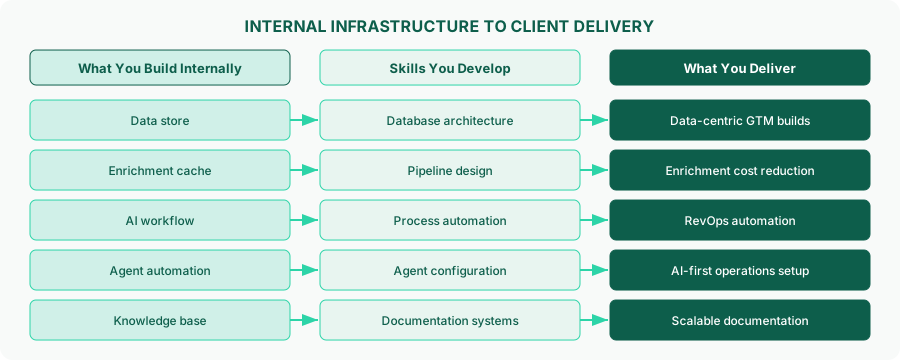
Most RevOps consultancies and agencies will pitch you a methodology. A framework on a slide. A process they have designed but never had to live inside themselves.
The difference with an AI-first consultancy is that the infrastructure they build for you is the same infrastructure they run their own business on. That distinction matters more than it sounds.
When your RevOps partner has built and operated their own data store, they know the real migration path from CRM-centric to data-centric architecture. Not the theoretical one. The one where you discover that your HubSpot custom objects have circular references that break the sync on day three. The one where the enrichment provider's API returns a different schema on weekends. They have already hit those walls and built around them.
When your partner runs their own enrichment cache, they know exactly what hit rates to expect, when to invalidate stale data, and how to structure multi-provider lookups so the cheapest source is tried first. Most companies overspend on enrichment by 40-60% because they have no caching layer. You should not have to learn that lesson through your own budget.
When your partner runs AI-assisted workflows on their own projects daily, they know what AI handles reliably and where it falls over. That saves you from the expensive discovery period most teams go through: three months of experimenting, finding the boundaries, and rebuilding the things that did not work. Your partner has already done that experimentation on their own time and their own budget.
The question worth asking any RevOps consultancy is not "what is your methodology?" It is "do you run your own business on the same systems you are proposing to build for me?" The answer tells you whether you are buying proven patterns or untested theory.
This is not a one-time investment. It is a compounding loop.
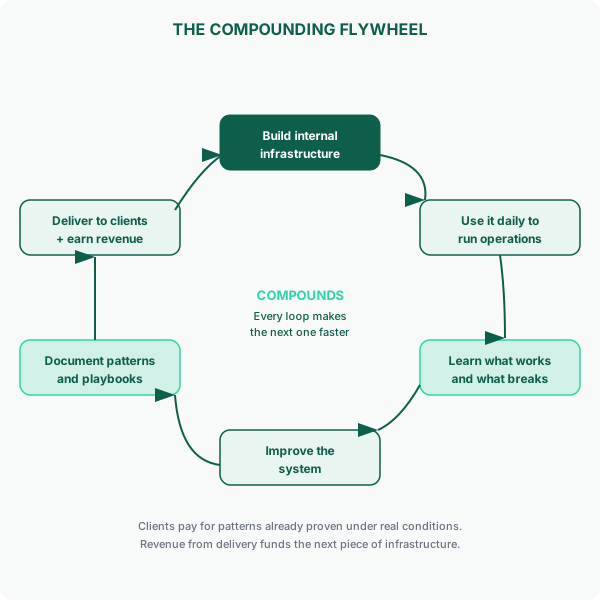
Every loop makes the next loop faster. You build a piece of infrastructure. You use it daily and discover the edge cases. You improve it based on what you learned. You document the patterns. You deliver the same patterns to a client (faster, because the problems are already solved). The revenue from that delivery funds the next piece of infrastructure.
The more loops you complete, the more opinionated and battle-tested your approach becomes. Clients are not paying for theoretical recommendations. They are paying for patterns that have already been proven under real conditions.
You do not need to build all four layers at once. Start with the one that solves your biggest pain point and expand from there.
If your biggest problem is data locked in silos: Start with the operational data store. Get a managed Postgres instance running, move your enrichment caching there, and connect it to your AI agent. This alone eliminates duplicate enrichment costs and gives you a single queryable layer that sits beneath your existing tools.
If your biggest problem is operational overhead: Start with the AI agent. Connect it to your project management tool and your documentation platform. Let it handle task creation, status updates, and doc maintenance. You will get 2-3 hours back per day almost immediately.
If your biggest problem is losing context: Start with the knowledge base. Structure your documentation so the AI agent can search and reference it. Document your decisions, your architecture, and your common workflows. The agent gets dramatically more useful once it has context to work with.
If your biggest problem is inconsistency: Start with the work tracking layer. Get a project management tool with native AI features and a clean API. Let the agent triage and template your tasks. Consistency comes from structure, and structure comes from the tool.
The order matters less than the commitment. Pick one layer, build it properly, and expand. Trying to build all four simultaneously is a recipe for none of them working well.
No. The managed services and no-code/low-code tools available today mean you can set up a Postgres database, configure an AI agent, and connect your tools without writing code. You will need to understand how databases work at a conceptual level (tables, relationships, queries), but you do not need to be a developer. AI agents can generate the code you need for database migrations, serverless functions, and API integrations.
Zapier and Make connect tools with point-to-point automations: "when X happens in tool A, do Y in tool B." AI-first operations connect tools through a shared data layer with an intelligent agent that understands context. The difference is that Zapier workflows are rigid (they do exactly what you configured, nothing more), while an AI agent can make judgement calls based on the full context of your operations. Zapier also does not compound. Your 100th Zap is not smarter than your first.
The core stack can run on free or near-free tiers for a small team. Managed Postgres has generous free tiers. AI agent subscriptions run around $20-200/month depending on usage. Project management and documentation tools have startup-friendly pricing. The total cost is typically less than one contractor hire, and the operational capacity it adds is equivalent to 2-3 full-time roles.
The pattern works for any small team running a multi-tool stack where the integrations are rigid and context does not flow between systems intelligently. Consultancies benefit from the internal-to-client translation (you sell what you build), but product companies, agencies, and internal teams all hit the same ceiling: well-integrated tools with no shared intelligence layer. The architecture is the same. The specific tools might differ based on your stack, but the principle of shared data layer + AI agent + structured documentation applies universally.
The first layer (whichever you start with) typically shows results within 1-2 weeks. The enrichment cache starts saving money immediately. The AI agent starts saving time on its first day. The compounding effects take longer. Give it 2-3 months before the flywheel really starts spinning, when the documentation is rich enough that the agent's output quality noticeably improves.
This is the first post in a series on building AI-first operations. Coming next: What MCP Actually Means for Business Operations, Building a Clay Enrichment Cache That Saves 40-60% on Lookups, Why We Built an Operational Data Store Instead of Making HubSpot Do Everything, How AI Agents Run a Two-Person RevOps Consultancy, AI for B2B Revenue Teams: What Actually Works in 2026, and Why Most AI Implementations Fail (and What to Do Differently).

%20(1).jpeg)